
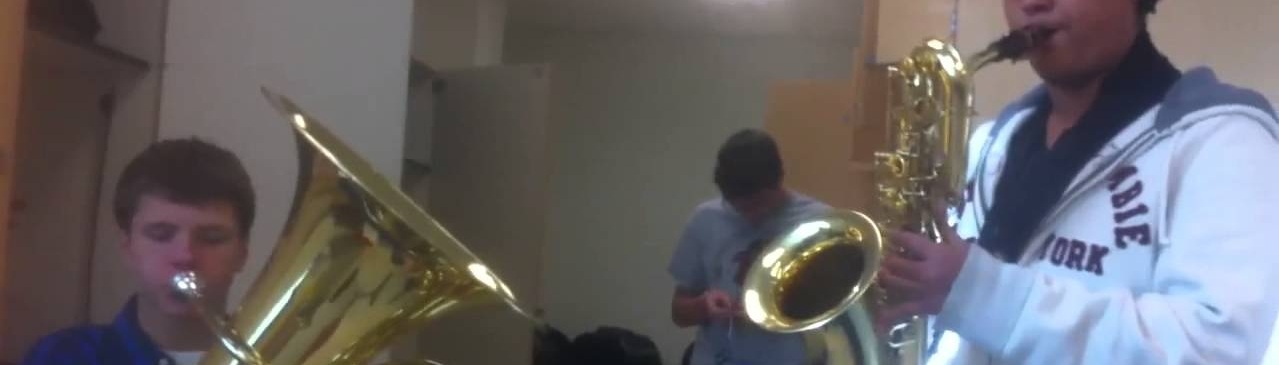
Converting Tuba Parts for Bari Sax: A Practical Guide for Band Directors
Who
This technique is for band directors in middle school or high school programs who need to quickly adapt existing tuba parts for a bari sax player. It’s especially useful when a new bari sax student joins late, when marching band parts don’t exist for the instrument, or when the method-book inventory doesn’t include books for every student.
What
The task is taking a tuba part written in bass clef (concert pitch) and rewriting it so a bari sax can play the same sounding notes. This requires changing the clef from bass to treble and adjusting the key signature by adding three sharps (or the equivalent flat reduction).
Why
Tuba parts are written at concert pitch. Bari sax is an E♭ instrument that transposes down a major ninth. Changing the clef and adding three sharps transposes the written part up a major ninth so the bari sax’s sounding pitch matches the original tuba line. The second line of bass clef is the tuba’s concert B♭. The second line of treble clef is the bari sax’s written G. After transposition, that written G sounds concert B♭—the same pitch the tuba was playing on second-line bass clef.
Where
The conversion is done on the written page:
- Clef change: Replace bass clef with treble clef.
- Key signature adjustment: Add three sharps (or remove three flats) to the key signature.
- Note transposition: Every note is rewritten up a major ninth (one octave plus a major second).
When
This conversion is most commonly needed when:
- A bari sax player joins the marching band mid-season and no dedicated bari sax parts exist.
- The program lacks method books for every instrument, so tuba exercises or etudes are used as a starting point.
- A tuba player is absent for a rehearsal or performance and the director wants to keep the low-end covered.
- A student shows strong musical ability on bari sax but the low brass section needs reinforcement.
How
Follow these steps to convert the tuba part:
- Change the clef from bass to treble. This shifts the staff up an octave minus a second.
- Adjust the key signature by adding three sharps. This is not always literal “add three sharps.” Example: Concert key is B♭ major (two flats). Adding three sharps means canceling the two flats (B♭ and E♭) and adding one sharp (F♯), resulting in one sharp (G major written for bari sax). Concert key of F major (one flat) becomes D major written (two sharps). Concert key of E♭ major (three flats) becomes C major written (no sharps/flats).
- Double-check accidentals. This step takes extra care.
- A natural sign in the tuba part becomes a sharp or flat in the new key signature.
- Watch for double flats or double sharps that can appear after transposition (e.g., a tuba double-flat B♭ becomes a double-flat C in the new key—confusing for students).
- Watch for B#, E#, C♭, or F♭—notes that are theoretically correct but rarely written that way in student parts. Rewrite them as C, F, B, or E whenever possible to avoid confusion.
- Verify with a tuner. Play the converted line on bari sax and confirm it matches the original tuba pitch (A=440 Hz).
- Practice the converted part. Transpose a Bb major tuba scale (becomes D major written for bari sax) to help the student get comfortable with the new notation.
Conclusion
Converting tuba parts for bari sax by switching bass clef to treble clef and adding three sharps (or the equivalent flat reduction) keeps the sounding pitch correct when tuba parts are missing or books are short. The key equivalence—bass clef second line Bb (concert B♭) becomes treble clef second line G (written G, sounding concert B♭)—is the anchor point. Extra care with accidentals and double sharps/flats prevents confusion for the student. Directors who master this quick rewrite can keep the low end covered and give a capable bari sax player meaningful playing time, strengthening the entire ensemble sound.